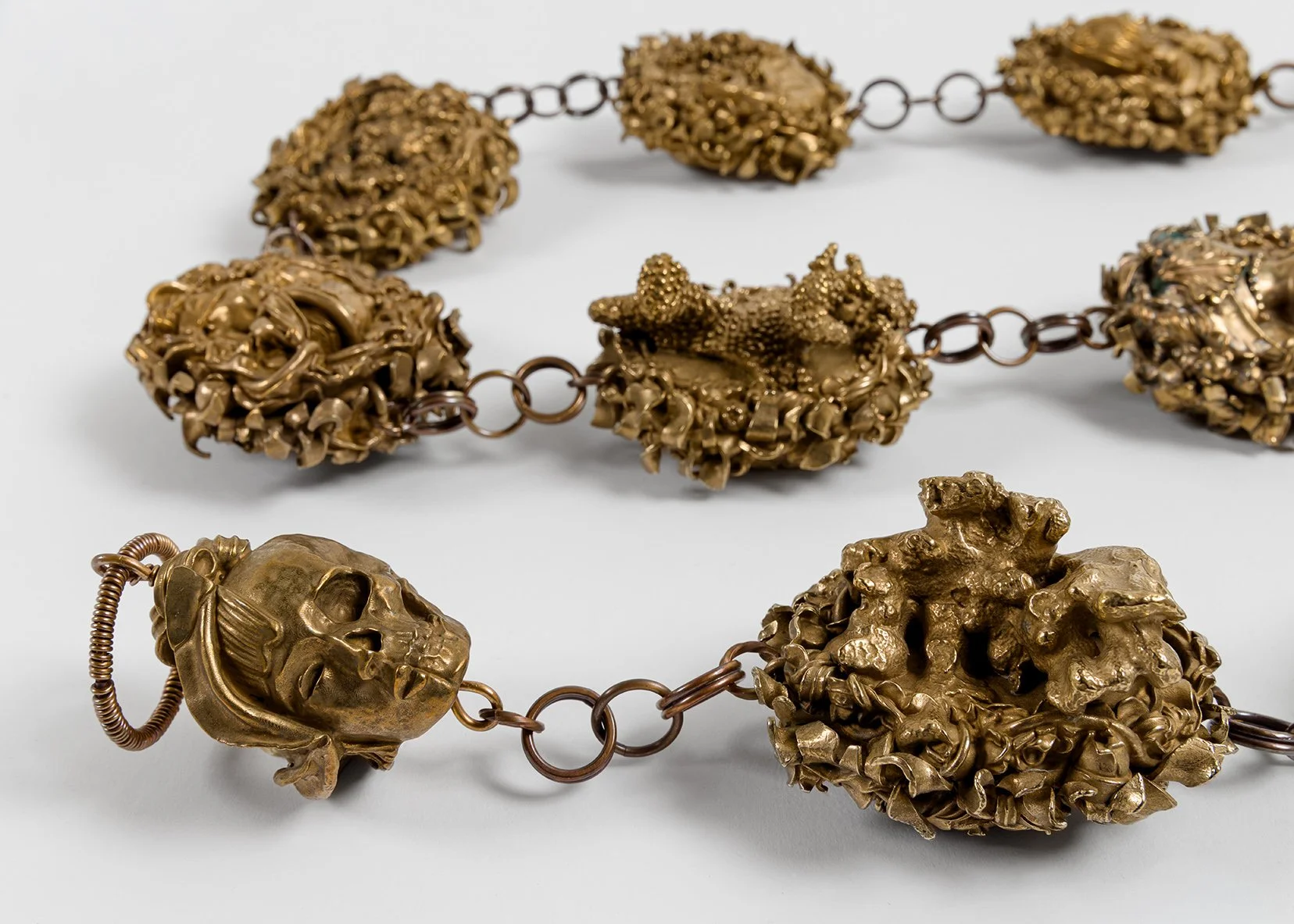
DIVER CHAIN, 2025
Photography: Etienne Frossard
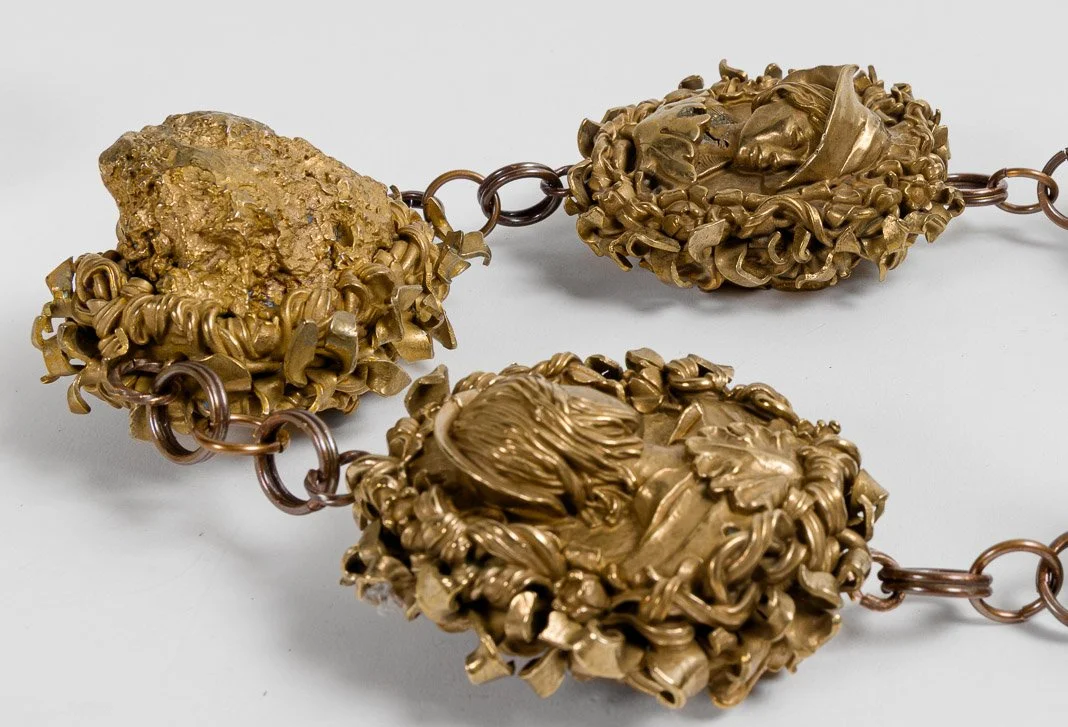
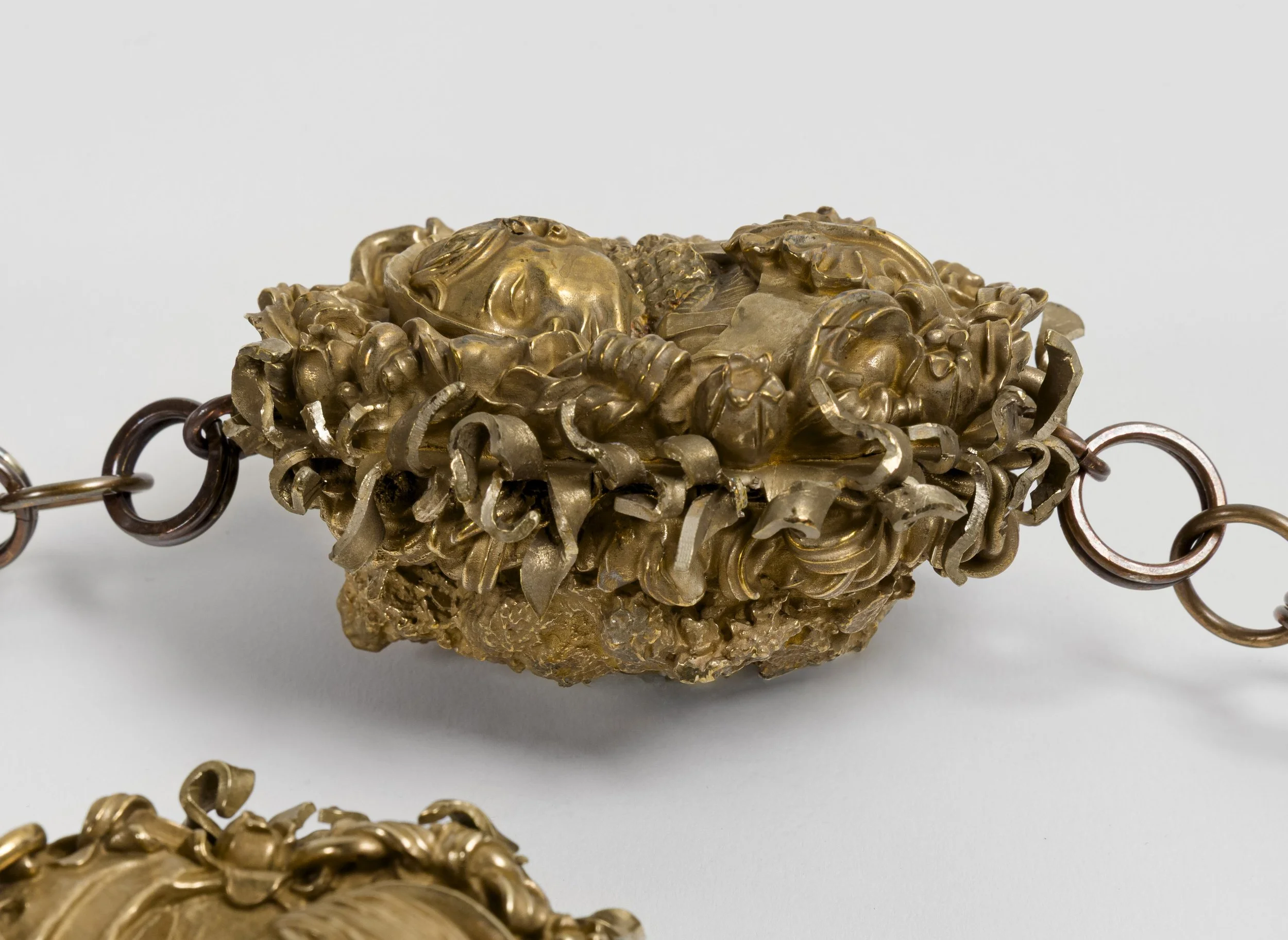
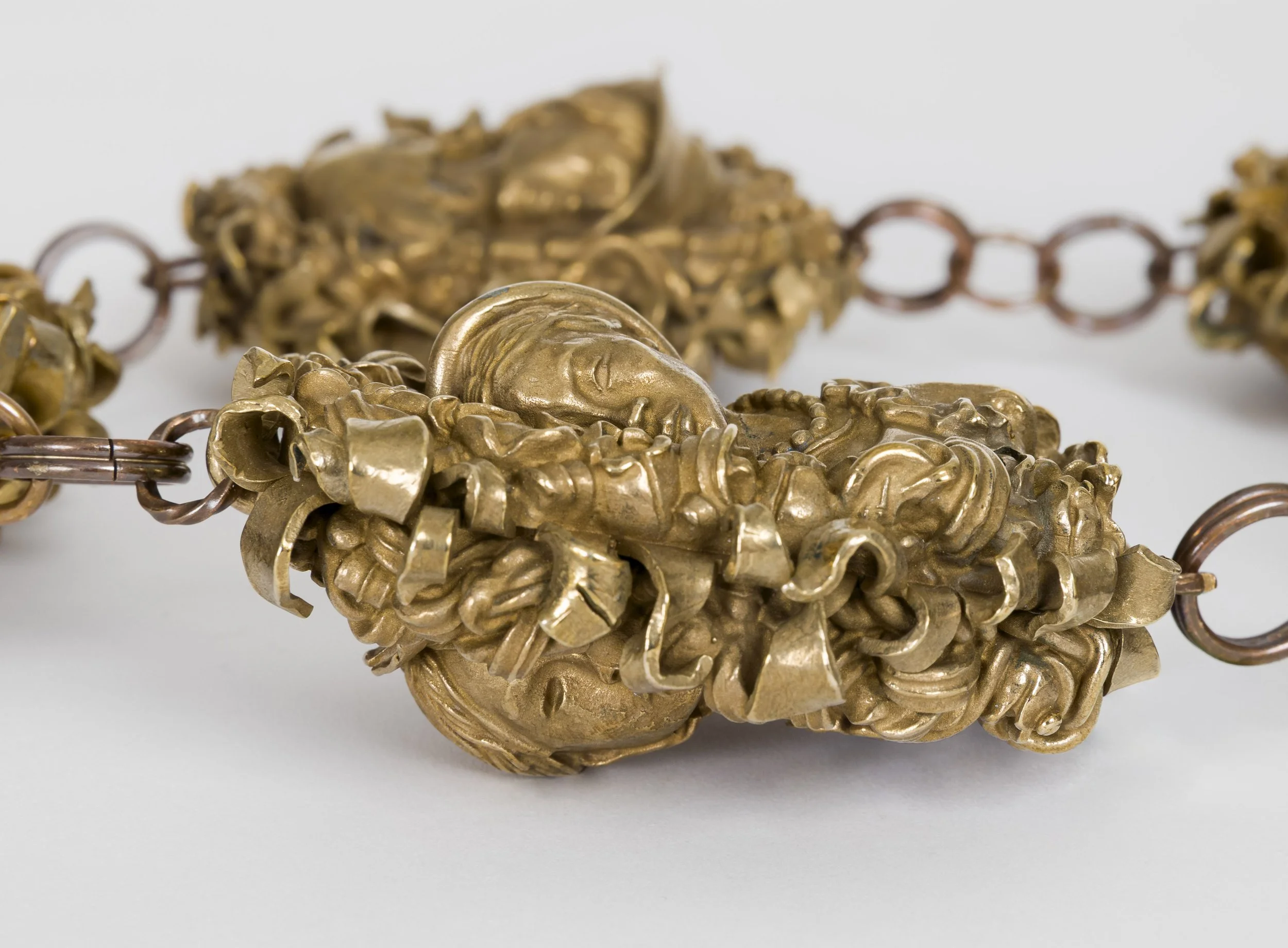
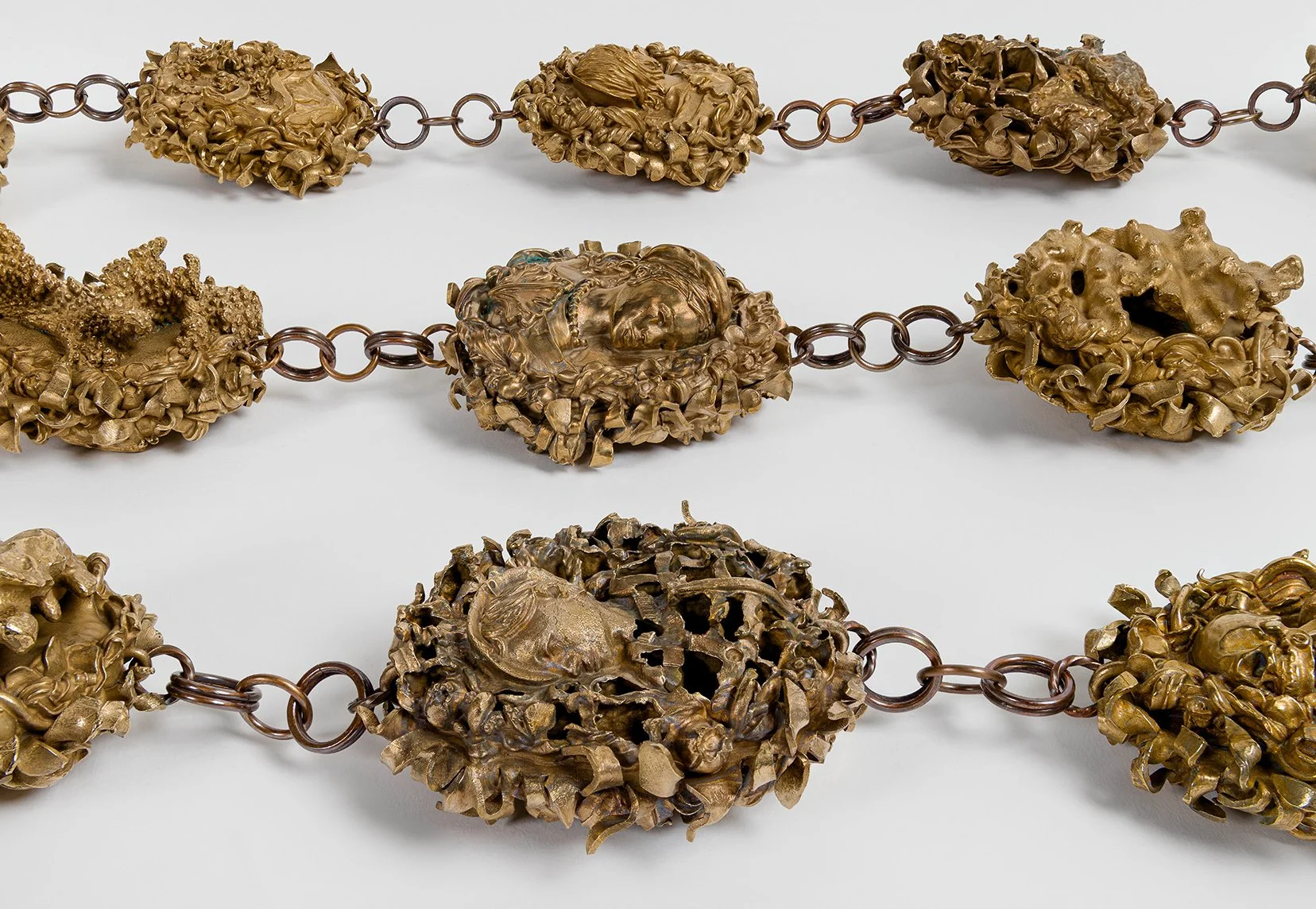
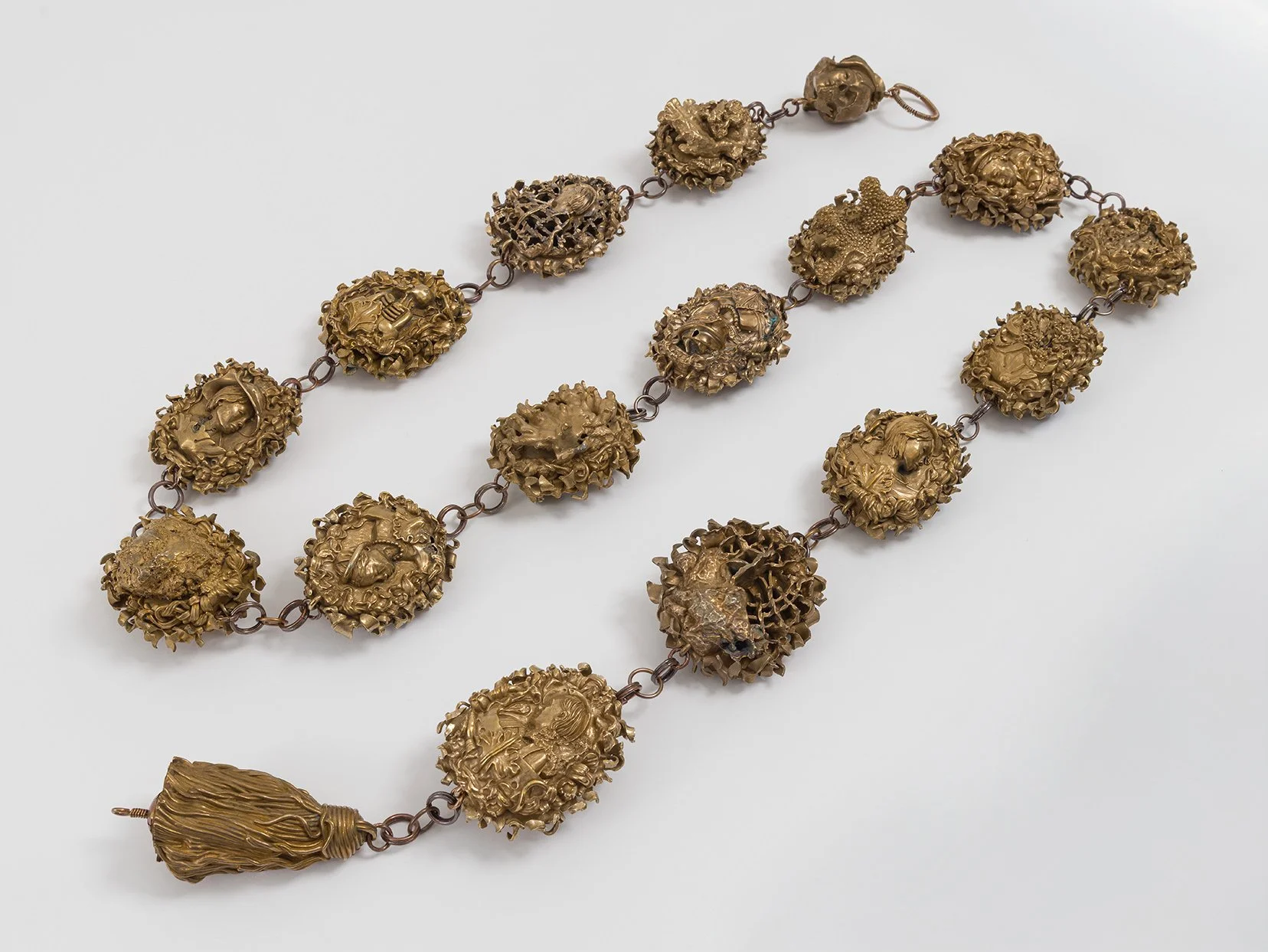
Diver Chain, 2025
Bronze, 2.5 x 84 x 3.5 in
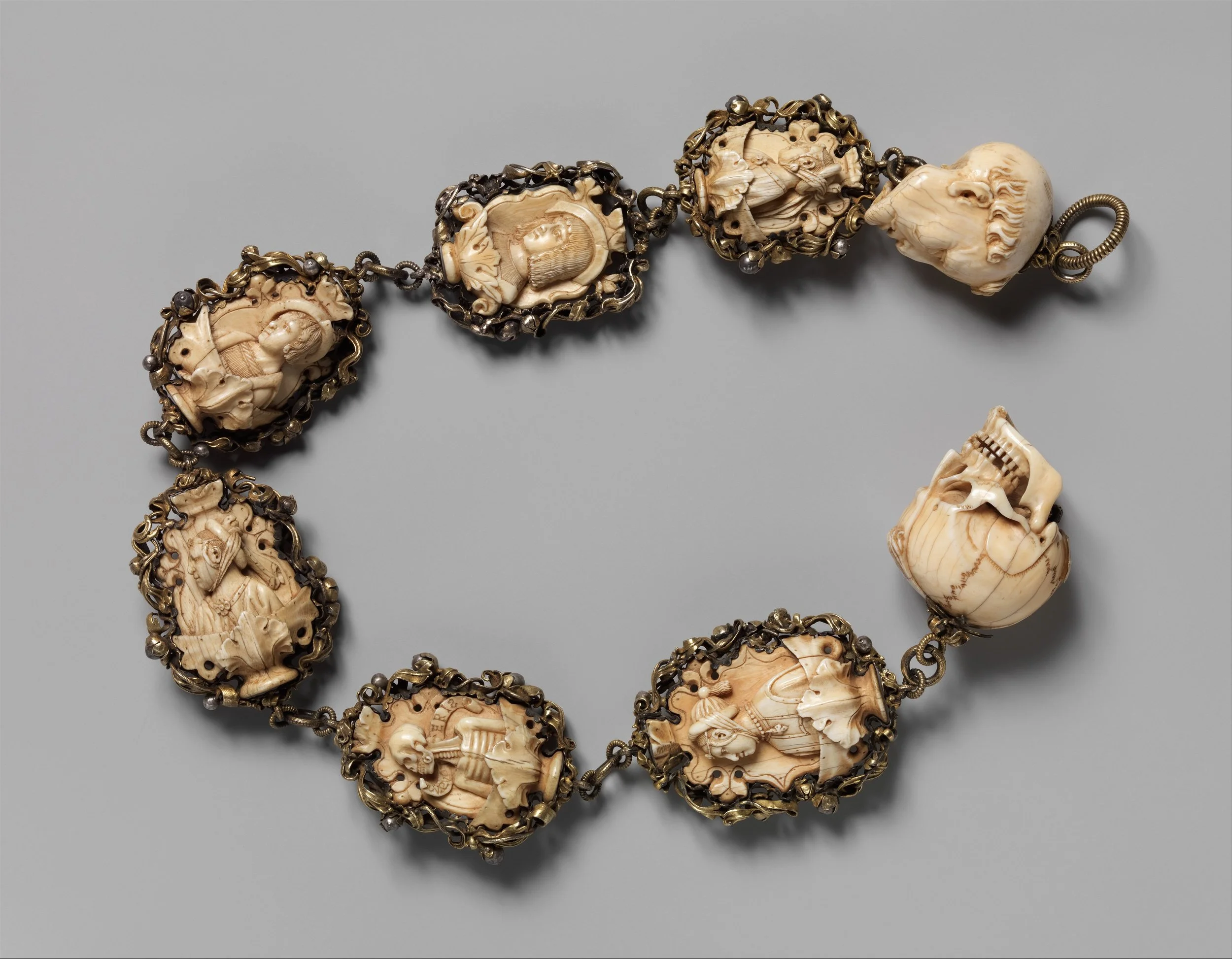
In late 2021, in the shadow of the pandemic, I noticed a strand of devotional beads during a visit to The Metropolitan Museum of Art. This 500-year-old rosary (17.190.306), intricately carved from elephant ivory and embellished with gilded silverwork by artisans in late medieval Europe, captured my attention and imagination. It featured six reversible beads and two terminal pendants – miniature sculptures designed to fit within the palm or to be grasped by thumb and finger. The double-sided beads displayed portraits of wealthy and fashionable urbanites (“burghers”) carved in high relief and set within decorative plaques. The design integrated several frightening surprises: the reversal of two portrait beads revealed each sitter’s skeletal counterpart, while the terminals showcased bifurcated heads in the round, half bone and half moldering flesh. The precise carving permitted recognition in the dark: any minute part, even teeth, could be discerned by touch. When I left the museum that day, I was still holding onto the object as something to think with. It would eventually take three years to grapple with the aesthetic and conceptual task of reinterpreting this memento mori through my sculpture practice. I wanted to echo its form yet rewrite its meaning.
The design of the memento mori foregrounded rotation, variation, and different outcomes. I wanted to turn the object, to reimagine and reencode it with a plurality of content: other remembrances, histories, and lineages. Resistance to a fixed meaning or identity through an ever-changing format resonated with a twenty-first-century experience. I rode the subway to my studio residency at the Museum of Arts and Design, and I wondered about the anonymous burghers in the memento mori and the passengers around me. What could I recover from the past and reinscribe in the present? In my studio I decided to work blind – to grasp and shape the clay without knowing whom or what I would encounter.
I built up modeling clay over a substructure, and I used my face as a proportional guide to work at life size. It seemed that each touch and press and bit of clay added or removed revealed a slightly different face, each supplanting the one before. Perceived resemblances to family members caught my attention and began to activate my visual memory of those who were 5,000 miles away, several decades in my past, or known to me only through black-and-white photographs. I began to respond to this sensation of likeness, shaping the clay intuitively until I felt I was kin to the face I saw. I worked until the sudden immediacy of recognition stopped my hand – when I recognized in physical form a visual echo from my memory. I used this process to sculpt six portraits of women. These faces resembled my mother, my aunt, and other family members, but not in the present – only as I remembered them in the distant past, as far back as my childhood.
I followed the pattern of the memento mori while exploring recombination. I remixed garments and adornment from across time and place, shaping forms that resembled my grandmother’s jade and pearls over sixteenth-century pleats and folds reproduced in clay. The Met Gala took place as I worked on the portraits, and I noticed photos of two actresses, Zendaya and Anna Sawai, twinning in matching suits and wide floppy hats. Their identical hats seemed to match the ones worn by the burghers in the memento mori. Extravagantly out of step with the lives of my family members, I confiscated this beautiful hat and gave my subjects agency to participate in a performance with another kind of status.
Around each portrait and a sculpted skeletal bust, I modeled an undulating border of leaves, vines, and fruits. Although these intertwined forms emulated the gilded silverwork in the memento mori, it was the natural environs of my family’s home in Hawai`i that I saw preserved in these shapes. Taking in a wider view of the Pacific and of time itself, I sculpted a plaque of Amborella flowers at all stages of bloom. The oldest living ancestor of Earth’s flowering plants, Amborella trichopoda exists in the wild only on the main island of New Caledonia in Melanesia. Its sex determination is plastic and not fixed: an individual plant can change sex between flowering seasons. Following its lead, I switched the gender of the bifurcated terminal pendants, exchanging the decomposing men for a woman with a half bob and a sectional cut through her floppy hat. I sculpted a curvaceous and flowing tassel to stand in for the lower half of a body, with the beads seemingly forming an elongated spine between the terminals.
In the final phase of sculpting, I continued to experiment with overlay and doubling as technical and conceptual procedures. In contrast with traditional clay casting when a mold is used to produce an exact copy, I claimed the negative space – the cavity inside the mold – as a support structure for an entirely different process. I shaped soft clay into an irregular lattice within the negative space to produce something other, while also encoding traces of the pattern. Demolding revealed hollow voids and cavernous pockets surrounding the subject. These honeycomb-shaped cavities resembled the effect of saltwater weathering on volcanic rock and skeletal coral limestone at the beach near my family’s home. Additionally, by using an impression mold taken from the actual surfaces of eroded rocks and corals, I reinscribed their textures onto the clay sculptures to merge time and place. These experiments led to variations in which the cavities, pits, and textures replaced the visage entirely.
Bridging ancient and contemporary techniques, the portrait plaques – each sculpted by hand at a 24-inch length – were 3D scanned, downsized to four inches, and digitally paired with different obverse and reverse sides. The terminals were also scanned and scaled down. Additionally, I scanned pieces of coral rubble – the skeletal remnants of ancient corals that my mother unearthed while digging in our backyard – and digitally combined these with three of the sculpted plaques. Finally, a thin, starburst-shaped plane was digitally inserted and sandwiched between the paired sides of each bead. The files were 3D printed in wax and cast in bronze, and I preserved imperfections in the casting process to suggest time and transformation. A metalsmith hammered the starburst into an undulating sharp-pointed fringe to consolidate front and back of each pair, and then joined the chain with handmade links. Comprising seventeen solid bronzes, including two terminals and fifteen beads presenting unique up-facing sides, the chain spanned seven feet and weighed approximately 35 pounds. It had transformed into something other.
Doubling one text with another, in Craig Owens’s articulation of contemporary allegory, requires “attitude as well as technique, a perception as well as a procedure.” For the image to become something other, the rewriting of meaning in a primary text must take place “within” the work of art. As in a palimpsest, this relationship forms its structure, even if “fragmentary, intermittent, or chaotic.”
A diver guides my return to the ocean and my descent. The ocean reminds me to recognize and attend to time: geological, historical, cyclical, ancestral, solar, and the internal timekeeping of bodies and cells. The oceanic reveals collective continuance and pleasures of relation and adjacency. Art comes into being through the oceanic: through vast circulation of knowledge, culture, materials, commodities, profits, and people: artists, migrants, laborers, and the enslaved. “She lives in me. There is continuation: the grandmother, the mother, the daughter. We’re all linked in a chain, and we all live in each other.” (Isabel Allende) The chain is one thing after another; art is a link in the chain.
Thank you:
Museum of Arts and Design, fellowship and studio residency; Lower Manhattan Cultural Council Workspace, studio residency; Puffin Foundation grant award; Two Trees Cultural Space Subsidy Program; Mia Kaplan, metal fabrication; NYU LaGuardia Studio, CAD and 3D scanning; City Casting Corp., bronze casting; Harry Kleeman, mold making; Etienne Frossard, photography